We are committed to pursuing research into family-owned businesses that will inform and improve the support we provide as they navigate critical issues such as succession planning, governance, and next-generation leadership transitions.
The third survey in the Pulse of Family Business series examines how family businesses structure family governance and communicate across generations. The survey highlights the wide range of approaches to councils, meetings, and policies. It reveals both meaningful progress and significant opportunities for families to formalize governance structure as ownership expands and generational complexity increases.
Most families hold shareholder (64%) and family meetings (60%), yet fewer than half have a family council (45%), and only 11% report a NextGen council. Even among families with councils, only 40% have a budget and 60% provide no compensation, limiting their effectiveness. This indicates meaningful room for families to strengthen governance maturity through clearer structures, defined roles, and consistent resourcing.
Families diverge significantly on who counts as a “family member” for governance purposes. While 86% include bloodline descendants, only 50% include spouses and 27% include adopted or stepchildren. This creates notable differences in governance behavior: families with narrow definitions are less likely to have councils, less likely to use consultants, and far less likely to allow in-laws to serve (24% vs. 59% overall).
Families have made progress on foundational policies such as distribution (61%) and family employment policies (56%) yet major gaps persist. Fewer than 30% have a conflict-of-interest policy, only 22% have a social-media policy, and 75% lack any formal dispute-resolution process, leaving families vulnerable as ownership expands. Strengthening these policies presents a clear path to improved alignment and risk management.
Our second survey focuses on succession, the defining milestone of a multigenerational family business. Without a transition in leadership or ownership, there’s no next generation to plan for. In the U.S., family businesses often reach the third generation, but that doesn’t mean the handoff is easy. Even well-prepared families can find that succession is rarely smooth or free of challenges.
Two-thirds of respondents described their most recent succession as “smooth” or “very successful,” yet confidence in the next transition has declined. Just 59% believe the next succession will go well. Why? Only 39% have a plan in place or in progress for their next leadership transition—compared to 73% who had one last time.
The data shows a clear correlation between having a formal, written succession plan and improved outcomes. Families with written plans rated their transitions as successful 78% of the time, compared to just 47% without one. Verbal plans help, but fall short of the benefits delivered by documented strategies.
Respondents point to five recurring challenges:
A. Letting go: Many senior leaders hesitate to relinquish control, even when successors are ready.
B. Lack of communication: Unspoken expectations and family dynamics often stall progress.
C. Merit vs. tradition: Choosing successors based on capability rather than family rank creates friction but yields better outcomes.
D. Preparation gaps: Not all NextGen members feel equipped to lead when the time comes.
E. Diverging visions: Older generations tend to prioritize stability; younger ones lean into innovation and risk.
Our first survey shows more than half of families don’t know if the next generation is ready, willing, or able to take over. Families also feel that family engagement is vital for the long-term success and stability of multigenerational family businesses.
A significant challenge for family businesses is the uncertainty regarding whether the next generation will join the business. According to the survey, 57% of respondents are unsure if their next generation intends to join the family business, while only 19% confirmed that the next generation has already joined
Family councils play a crucial role in improving family engagement. The survey shows that businesses with family councils report a 10% higher engagement rate compared to those without one. However, only 47% of family businesses currently have a family council
Families with higher engagement levels report better alignment on both family and business goals. In fact, 71% of highly engaged families say they are aligned “all of the time,” compared to only 43% of less engaged families
78% of respondents require next-gen members to work outside the business first, while 50% require them to report to non-family members and 43% mandate specific educational qualifications such as certifications or an MBA
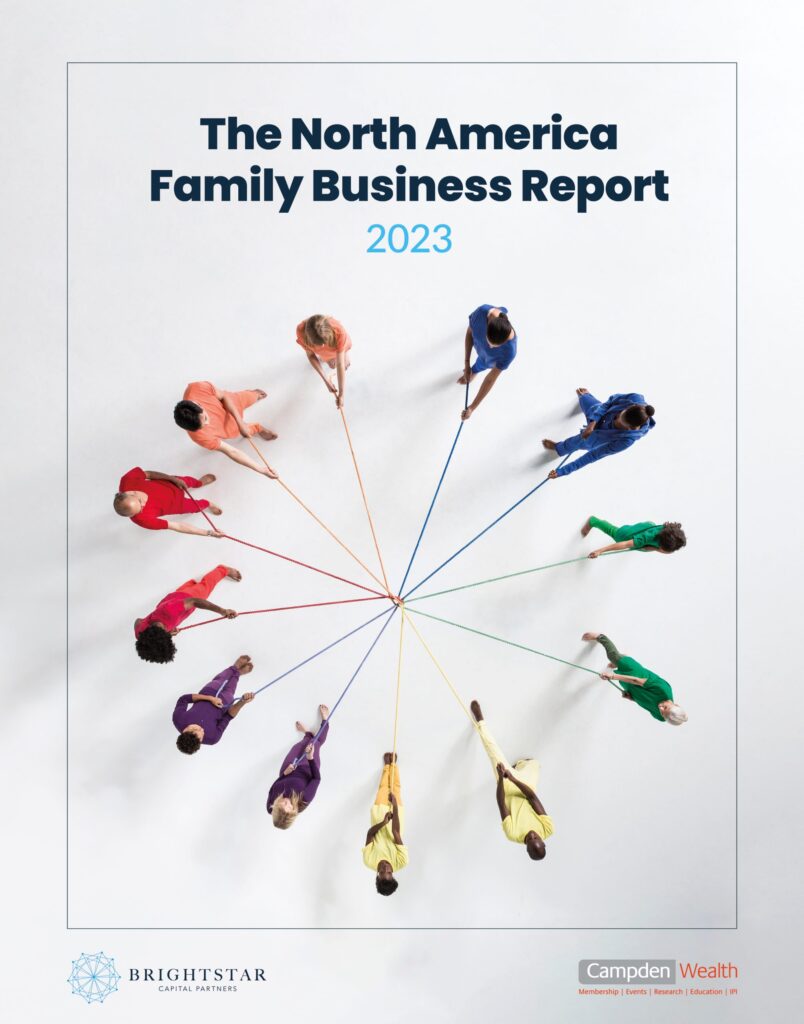
Brightstar Capital Partners and Campden Wealth issued the North America Family Business Report 2023, highlighting opportunities and challenges of family businesses. The report surveyed more than 100 family businesses with average annual revenue of close to $350 million. Among the major concerns for family businesses leaders are succession planning, risks of the current economic environment, family conflict and communication, technology investment, risk management, governance, cybersecurity, and ownership structure.